

A few weeks ago, I talked about the explosion of brooches on the Oscars red carpet. This was amazing serendipity because I’ve been thinking about the larger idea of the brooch for some time. I’ve never really gotten into them myself but I’ve always been intrigued. They were a staple in my grandmother’s wardrobe so maybe I considered them somewhat old fashioned?
wrong. wrong. wrong.
Brooches are probably the most fashion forward accessory right now. This makes sense in a TMI, all access, 24/7 news cycle world. The brooch is indeed an outward declaration and decoration but at the same time, it is able to hold deep meaning.
For centuries, brooches have been used to communicate, honor, celebrate, mourn. There are genres of brooches and sub-genres, and sub-genres of those sub-genres.
After the death of her beloved husband Prince Albert, Queen Victoria wore mourning jewelry (and clothing for that matter) anchored by a mourning brooch. The Victorian piece pictured below is a prime example. It’s reversible with room for a photo on one side and a braided piece of human hair on the other.


Macabre? Perhaps, but it’s nothing new. In Judaism, mourners create an impromptu brooch of sorts through the act of kriah, the tearing of clothing. Some mourners tear their actual clothes and others tear a ribbon pinned to their clothes but the whole idea is to outwardly express one’s grief.
So of course I went down a deep rabbit hole, finding more examples than I could even begin to write about.
Then, BOOM. A mic drop moment.
My search produced a book that made me realize that there’s an entire side of these pieces that I didn’t consider.
The idea for the book was partially hatched out of frustration.
It may seem pretty obvious but the backs of brooches are sometimes more stunning than what the public will ever see. Mexican-American artist Lorena Angulo, wrote Behind the Brooch because she knew her brooch backs were carefully constructed and considered. But what about everyone else?
“I have always enjoyed making jewelry as attractive in the back as in the front…..I wanted to see how other artists finished the back sides, and if they may have a story tell on the back, too.”
After looking at scores of backs of brooches, I realized that in essence, the back of the brooch is the most personal piece of the object. It is a direct message, almost a secret understanding between artist and wearer. Some people wear brooches as pins and others wear them as pendants but no matter what, this part of the piece is hovering near your heart.
“The back of a pin (the part that touches the body) is where the magic is,” writes American artist Kimberly Nogueira. “It’s where the soul of the piece is.”
I asked Lorena to walk me through a few of her favorite pieces—front and back, of course. [interview has been edited for length]
For Kathleen
Claire Holliday, one of Lorena’s earliest teachers at San Antonio’s Southwest School of Art, encouraged her to wear her jewelry as much as possible: out to lunch, shopping, running errands. On one of these days, she walked into a high end boutique in San Antonio and quickly met the owner, Kathleen Sommers. Their conversation went a little like this (totally paraphrasing here):
Kathleen: What are you wearing around your neck?
Lorena: Oh, I made it.
Kathleen: You made it? Do you sell your jewelry?
Lorena: Of course. [she did not]
Kathleen: Perfect. I’ll see you this Wednesday, [it was Sunday] bring me your collection.
Lorena had three days to get it together and Kathleen Sommers inadvertently kicked off Lorena’s jewelry career. She even helped with pricing: “She would say ‘you don't have to justify your price to anybody. That's the price of your art. It's not just the cost of the materials. It's your craftsmanship, it's you, and you have to give yourself value for that.’ ”
In 2018, Kathleen Sommers died after a long battle with cancer; Lorena created this brooch in her honor. A mourning brooch of sorts but also a wearable memorial.
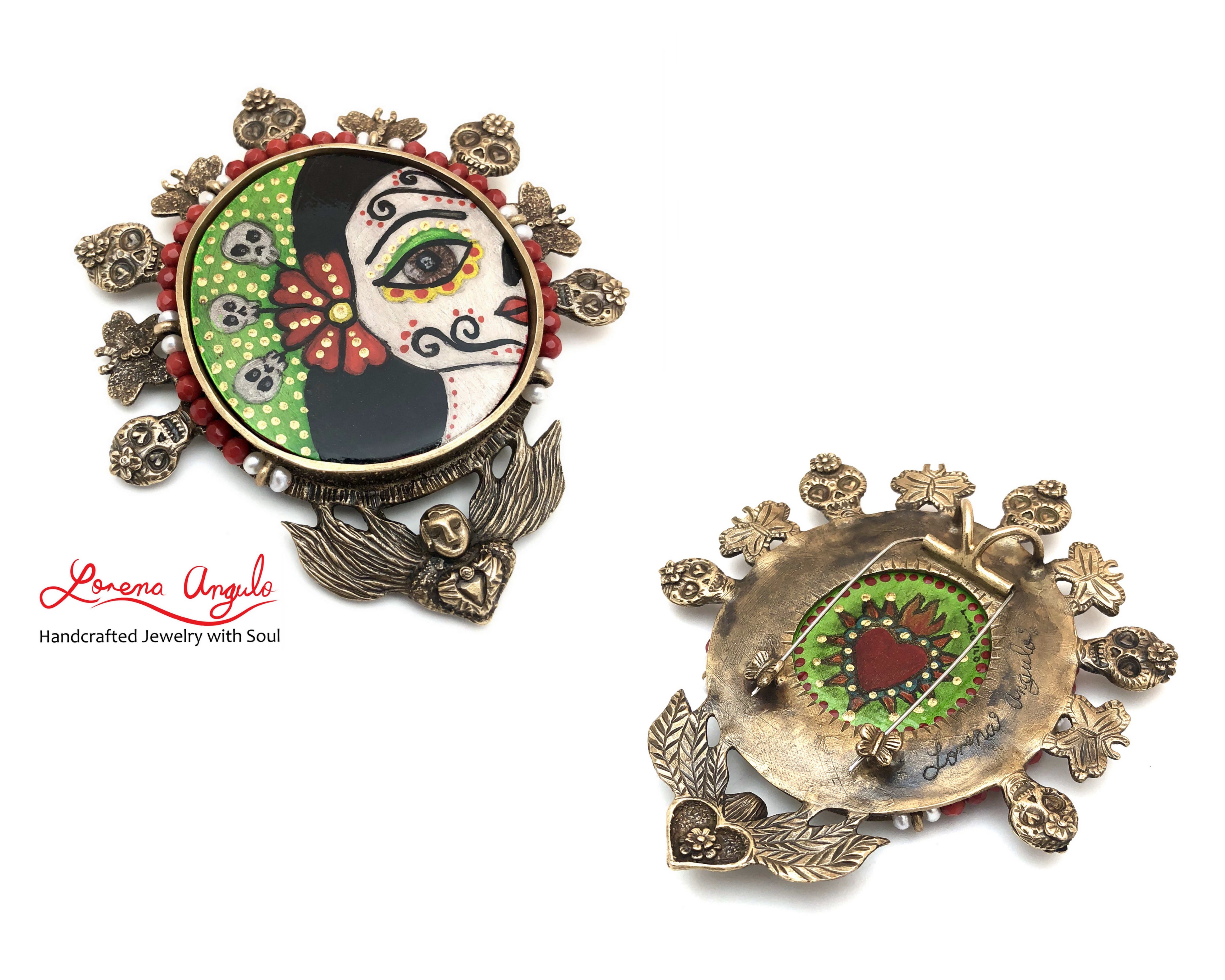
This piece incorporates a lot of the symbols from the Day of the Dead. The painting that I made myself is the centerpiece. Then you have the sugar skulls all around the frame, the little butterflies, because in Mexico we say that's the transition of the soul. So that's a representation of the butterflies in this piece, the angel, of course, because I think she was very soulful and very connected with angels so that's why I wanted to put a little angel in her piece, at the bottom.
On the back, I have a window with the heart. The catchers also are the two butterflies. The angel inside the heart has a flower because she loved nature and flowers.
But this was one of my first pieces, in a way, that I made in honor of somebody that I was very close to….I never sold it.
Mourning Brooch 2.0
Lorena’s father Jesus, died a year after Kathleen.
He worked as a civil engineer and the family moved around quite a bit as he took on new work.
“The mentality that people had about men in Mexico, that they are really macho and they don't let women do certain things. My father was actually the opposite. He was surrounded by women, you know, like my mom was a strong, strong woman. And we are four girls too..so he was forced to watch soap operas. There was no football in my house. So he was very, I think, up to date for his generation……I adored him. I was very attached.”
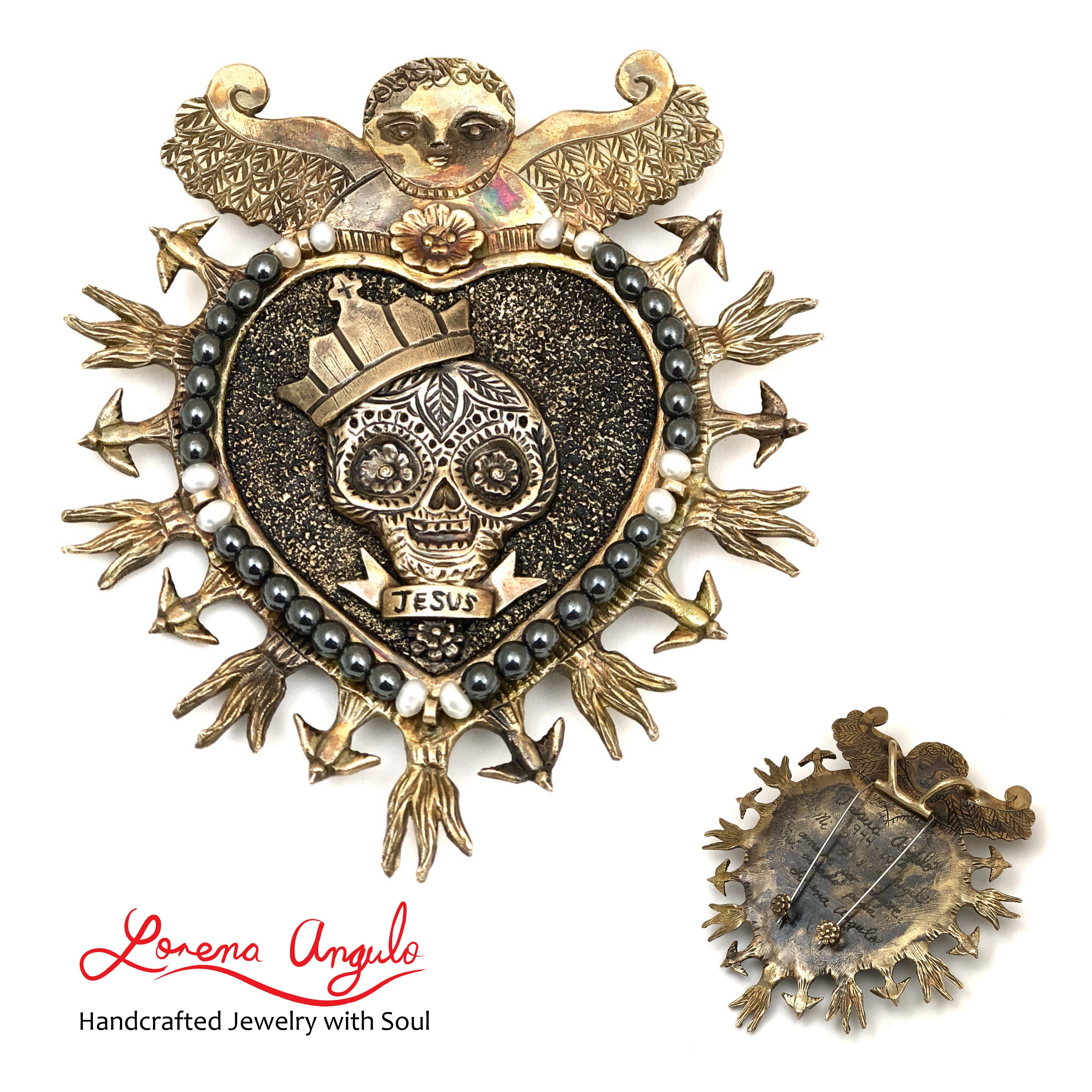
He has the sugar skull with the crown because he was the king of the house, and his name “Jesus” is under the skull. The angels and the Virgin of Guadalupe are images that I really carry on in my work. I have the flames because my father was very passionate about everything he did in his life.
On the back, you have the doves also that represent the Spirit. I didn't put a lot of design on the back, because I wanted to have the empty space to write something for my father. The catchers are two little flowers. And I also carved the angel. You can see the backside, carving the backside too. But this is also a piece that I didn't want to sell, so it's just for for my own use.
When Chemo (re)Inspires
A few years ago, Lorena was diagnosed with cancer for the second time.
“I wasn’t scared. I was angry.”
She decided to fuel this emotion into a brooch and anchored the piece with a milagro heart, a Mexican folk symbol that represents love and healing (amongst other things). “I just kept thinking…you know that the heart is going to absorb this [cancer] out of me and and when I survive this whole thing, I will look at the piece in a different way.”
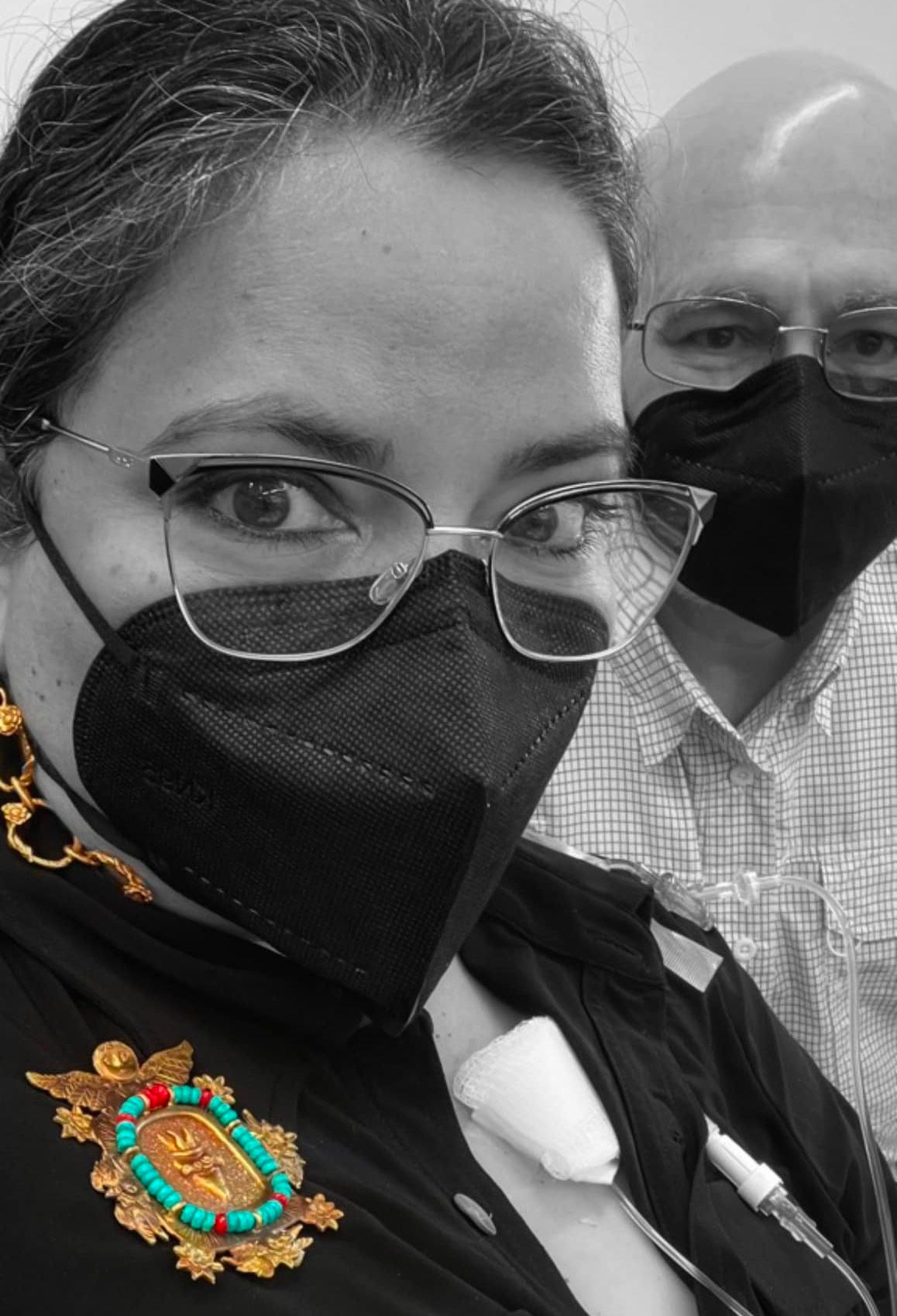
She calls this piece Resilient Angel.
The angel is my dad taking care of me, and the backside also carries a heart… where I engraved the word ‘resilient.’ I wore this piece my first treatment. I remember the nurses were like, Why? Because it's like, you usually don't see the cancer patients all dressed up with earrings and makeup.
At the end of chemo, Lorena created another brooch, The Queen.
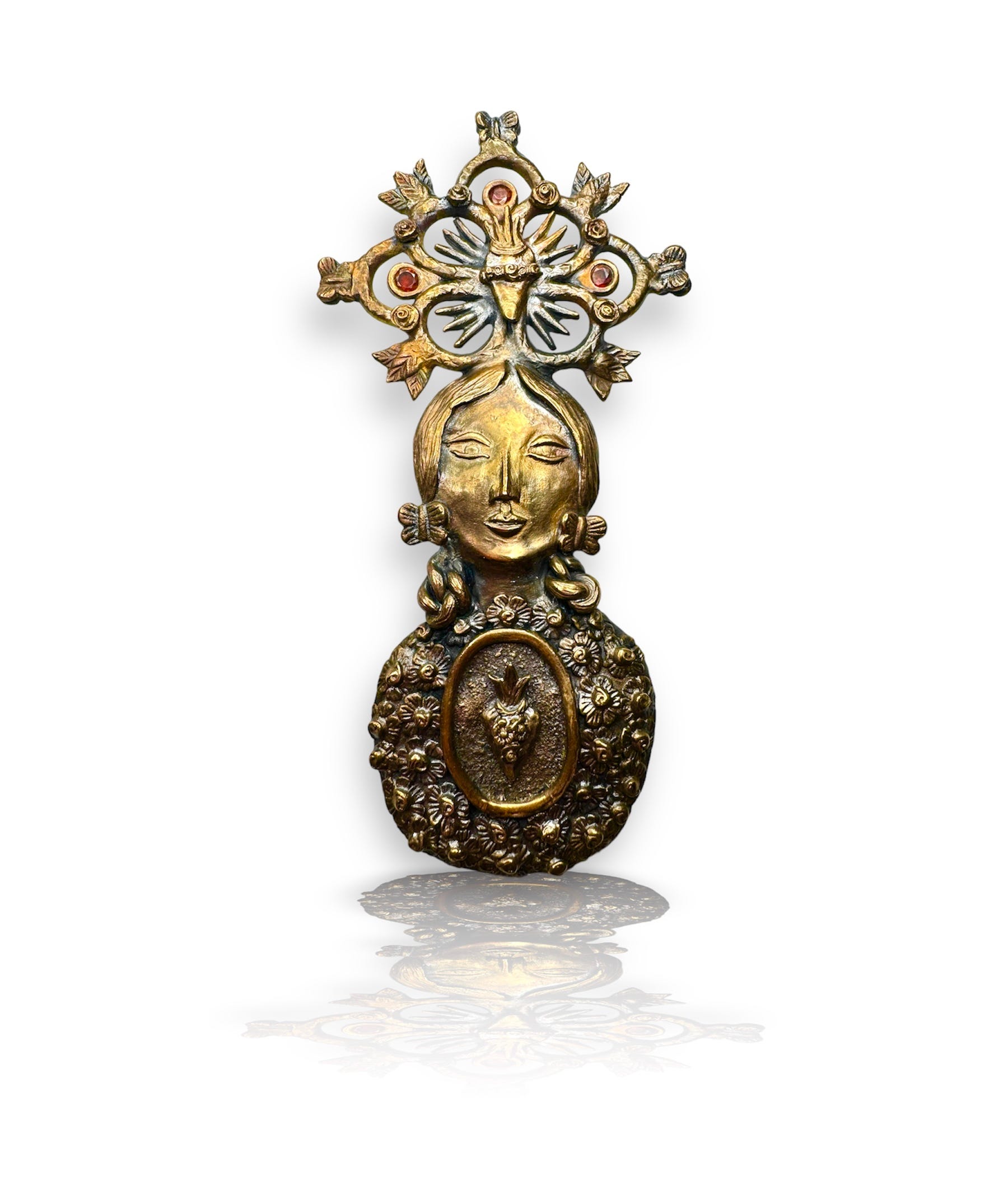
This is a lady who wears the tree of life…. her heart thumping, and her whole dress made of flowers. For me, when you go through any process in your life, not just an illness, you may feel like you're dying but you come back from that stronger, you know? So it's like when spring comes and you see the flowers coming out and the green in the trees. That's why I have this dress full of flowers, because yes I almost died, but I came out of that, I survived. There are two butterflies on the back, representing transformation because all the journeys in life, at least the way I see it … always teach us something good. So I just try to embrace what is good and with the bad, I just leave it behind. So besides the two butterflies, the back is very clean —a first for me.
I asked her to explain this a bit more.
I'm still recovering. People may see me and say ‘Oh my God, you look so good!’ but I'm like, ‘Yeah, but I'm still a mess inside.’ They [the doctors] gave me poison to kill this crap, you know. So while I have my struggles inside, I only show you the good side. Until I fully recover, the back of the brooch is for me.
In my mind, this is a uniquely powerful physical tool. The idea of “saving” our less than perfect side for ourselves is an act of self-love. The back of this brooch is a living monument to an active recovery.
Judy McCaig, a Scottish jeweler now living in Spain, is one of the jewelers featured in Lorena’s book. She wrote something that really stays with me:
Front and back are words that refer to the beginning and the end stages of a process. One cannot exist without the other. Together they make up the whole. As makers, we know that almost before studying the brooch itself, we have already turned it over to look behind.
For Lorena, the act of turning this piece over doesn’t provide an “end” or a definitive answer. Instead of waiting for someone else to finish the narrative, she maintains control over whatever she can, artistically and emotionally. I’m sure the piece will continue to evolve in the months to come.
She’ll share it when she’s ready.
Many thanks to Lorena Angulo for sharing her story with me. Find her work and videos of her process here.
Take care of your hearts.